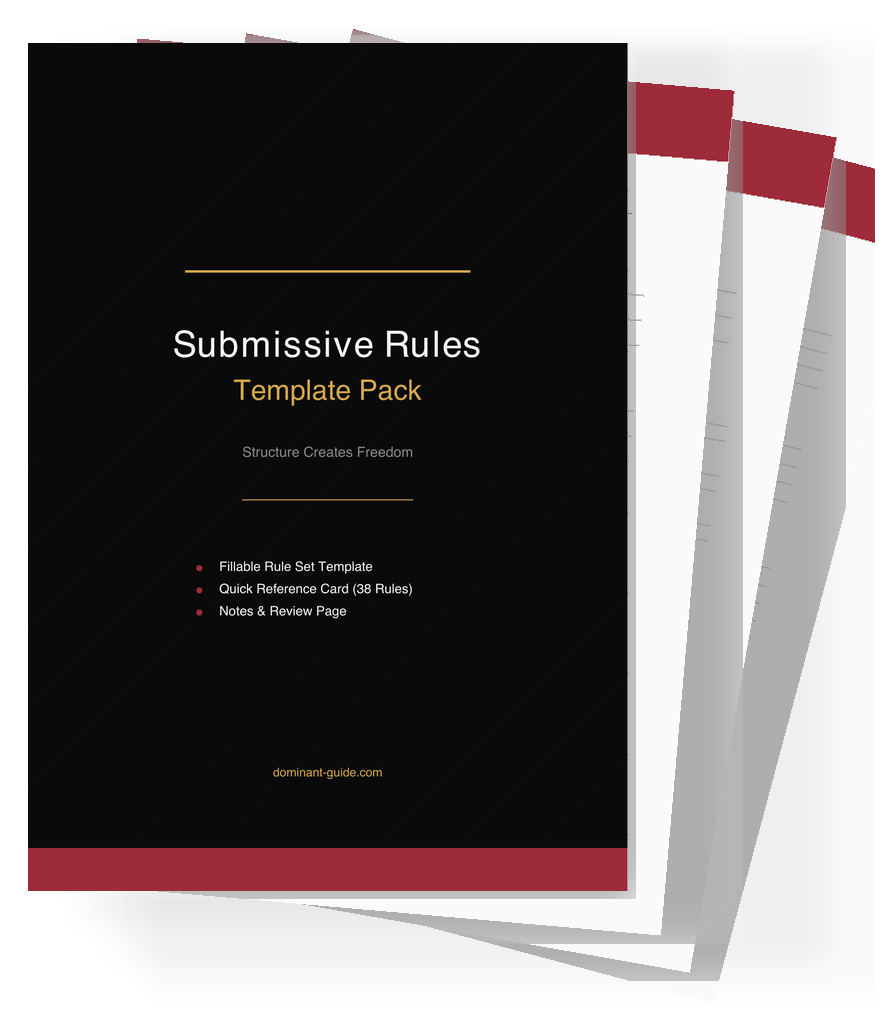

Rules aren’t restrictions. For a submissive, rules are the structure that creates freedom.
That’s the paradox most people outside D/s never understand. They see rules and think “limitation.” They see protocols and think “control.” They miss what’s actually happening - rules create a framework where a submissive doesn’t have to think, doesn’t have to guess, doesn’t have to wonder what you want. They already know. The rules told them.
That clarity is liberating. It removes the anxiety of uncertainty. It transforms “am I doing this right?” into “I know exactly what’s expected.” Within that structure, genuine submission becomes possible because the path is clear.
But here’s what separates effective rules from arbitrary ones: good rules serve the dynamic. They build trust. They create consistency. They develop the submissive’s capacity. Bad rules are just ego exercises - demands that stroke the Dom’s sense of power without actually strengthening the relationship.
This guide gives you 25+ actual example rules organized by category, plus templates you can customize immediately. These aren’t theoretical concepts. They’re practical tools you can implement today to build the structure your D/s dynamic needs.
Why Rules Matter in D/s
Rules are the operational framework of power exchange. Without them, dominance and submission remain abstract concepts that exist in scenes but dissolve in daily life. With them, the dynamic becomes tangible, consistent, present.
Rules create structure and safety. Your submissive knows where the boundaries are. They understand what’s expected. That clarity is psychologically safe even when - especially when - the rules themselves are demanding. Uncertainty is what creates anxiety, not high standards.
Rules establish clear expectations for both parties. You’re not guessing whether they understood your wishes. They’re not guessing what will please you. The rule makes it explicit. “Send me a good morning text by 9 AM” leaves no ambiguity. Both of you know exactly what success looks like.
Rules are the foundation for trust. When you enforce rules consistently, fairly, and with purpose, you prove yourself trustworthy. Your submissive learns that your word means something. That you follow through. That the structure you create is reliable. Trust isn’t built through grand gestures - it’s built through hundreds of small moments where rules are made, followed, enforced, and adjusted with care.
Rules define the dynamic. Two couples might both call themselves Dom/sub, but their rules reveal what that actually means. One couple’s rules focus on service and domestic protocols. Another’s center on sexual control and orgasm denial. Another’s emphasize behavior modification and personal development. The rules you choose define what kind of D/s relationship you’re building.
Rules provide consistency. Life is chaotic. Emotions fluctuate. Circumstances change. But rules remain constant. In the middle of a stressful week, when everything else feels unstable, your submissive still has the rules. Still has that structure. Still has clear ways to please you and demonstrate their submission. That consistency anchors the dynamic when everything else is shifting.
Rules give the submissive something to succeed at. Submission without structure can feel vague and frustrating. “Be submissive” is too abstract. “Kneel when I enter the room” is concrete. They can do it or not do it. When they do it, they’ve succeeded. They’ve pleased you. They’ve fulfilled their role. That success is satisfying in ways that vague submission never is.
Rules transform power exchange from a feeling into a practice. From an idea into a daily reality. From something that happens during scenes into something that structures your entire relationship.
Principles of Good Rules
Not all rules are created equal. Some rules strengthen dynamics. Others undermine them. Before we get to specific examples, understand these principles.
Start few, add gradually
Begin with three to five rules. Not twenty. Not fifty. Three to five.
Why? Because you’re establishing a pattern. You’re proving that rules matter by enforcing them consistently. It’s better to have five rules that get followed perfectly and enforced every time than twenty rules that get ignored half the time.
As those initial rules become habits - when they no longer require conscious thought or effort - you have space to add more. But not before. Don’t confuse quantity with quality. A small number of meaningful rules beats a long list of ignored ones every time.
Make them clear and enforceable
“Show me respect” is not a rule. It’s too vague. What does respect look like? How would you know if it was violated?
“Address me as Sir in private” is a rule. It’s specific. Compliance is obvious. Violations are identifiable.
Every rule should pass this test: could a neutral third party observe your submissive and determine whether they’re following the rule? If not, it needs to be more specific.
Enforceable means you can actually track whether the rule is being followed. Don’t make a rule about what your submissive does alone in their apartment if you have no way to verify it. Don’t make rules you won’t have time to enforce. Every rule you create is a commitment you’re making to enforce it.
Explain the WHY behind each rule
Your submissive will follow rules better when they understand the purpose.
“Text me when you get home” is just a demand. “Text me when you get home so I know you’re safe and because starting and ending the day with contact reinforces our connection” is a rule with meaning.
You’re not asking permission. The rule isn’t up for debate. But explanation creates buy-in. When they understand why a rule matters to you, compliance comes from wanting to please you, not just avoiding consequences.
This also forces you to examine your own motivations. If you can’t articulate why a rule matters, maybe it shouldn’t be a rule.
Rules should serve the dynamic, not just ego
Each rule should have a purpose beyond “because I said so.” Good rules either:
- Serve a practical function (tasks that need completion)
- Reinforce the power exchange psychologically
- Develop a specific skill or capacity
- Address a genuine need one of you has
- Create structure that benefits both of you
Rules that exist purely to demonstrate that you can make demands breed resentment. Your submissive can tell the difference between rules that serve the relationship and rules that stroke your ego.
If you can’t identify how a rule serves the dynamic, reconsider whether it should exist.
Customize to YOUR relationship
The rules in this guide are starting points, not prescriptions. Your dynamic isn’t like anyone else’s. Your submissive isn’t like other submissives. Your needs aren’t identical to other Doms.
Take these examples and modify them. Adjust the language to match your dynamic. Change the specifics to fit your reality. Add context that makes sense for your situation.
The couple in a 24/7 power exchange living together will have completely different rules than the couple who sees each other weekends. The Dom who values service will prioritize different rules than the Dom who focuses on protocol. Customize everything.
Review and adjust regularly
Set a schedule - monthly, quarterly, whatever fits your dynamic - to review all current rules.
What’s working? What isn’t? Which rules have become habits that no longer need enforcement? Which rules need adjustment because circumstances changed? Which rules should be retired because they no longer serve?
Rules aren’t meant to be permanent. They’re meant to be useful. When a rule stops being useful, change it or remove it. That’s not weakness - it’s good leadership.
Your submissive should be part of this review process. They have information you need about how rules are actually functioning in practice versus how you think they’re functioning.
Categories of Rules
Rules fall into different categories based on what they govern. Here are 25+ example rules organized by category. Use them as-is, modify them, or let them inspire your own.
Daily Rules
Daily rules create rhythm and routine. They reinforce the dynamic through consistent, repeated actions that happen every day.
1. Send a good morning text by [specific time]
Example: “Send me a good morning text by 9 AM every day, addressing me properly and telling me one thing you’re grateful for.”
Purpose: Creates a daily touchpoint. Ensures morning connection. Puts them in a submissive mindset to start the day.
2. Complete [specific self-care task] daily
Example: “Take your vitamins and drink at least 64 ounces of water daily. Report compliance each evening.”
Purpose: Shows that you care about their wellbeing. Demonstrates that your control includes caring for them, not just using them.
3. Report daily activities at [specific time]
Example: “Send a brief summary of your day by 8 PM - what went well, what was challenging, how you’re feeling.”
Purpose: Keeps you informed about their life. Creates a check-in point. Maintains connection even on busy days.
4. Maintain [specific standard] for appearance
Example: “Shave/groom according to our agreed standards before bed each night.”
Purpose: Extends your control to their body. Creates a daily reminder that they maintain themselves for your pleasure.
5. Practice [specific protocol] when greeting
Example: “When I arrive home, stop what you’re doing, stand to greet me, and wait for instruction before resuming activities.”
Purpose: Creates a transition ritual that shifts you both into your D/s roles. Demonstrates that your presence takes priority.
6. Journal about [specific topic] daily
Example: “Write three sentences each night about moments you felt submissive, grateful, or challenged in your submission.”
Purpose: Encourages reflection on the dynamic. Gives you insight into their internal experience. Develops their ability to articulate their submission.
7. Complete daily task list
Example: “Complete your assigned task list by end of day. Incomplete items require explanation and extension request by 9 PM.”
Purpose: Creates accountability for productivity. Gives you influence over how they structure their day.
Communication Rules
Communication rules govern how your submissive interacts with you, creating protocols around language, responsiveness, and respect.
8. Address me as [title] in private
Example: “Address me as Sir in private conversation, text, and email. Use my name in public or professional settings.”
Purpose: Creates a verbal reminder of roles. Distinguishes private dynamic from public presentation.
9. Ask permission before [specific action]
Example: “Ask permission before making plans that would take you away during our scheduled time together.”
Purpose: Demonstrates that your time takes priority. Gives you veto power over their schedule in specific contexts.
10. Report any health concerns immediately
Example: “Inform me within 24 hours of any injury, illness, mental health change, or medication adjustment.”
Purpose: Shows that their wellbeing is your responsibility. Creates transparency about their health so you can adjust activities appropriately.
11. Express disagreement respectfully, never disrespectfully
Example: “You may disagree with me, question my decisions, or express concerns. Do so respectfully, in private, never with disrespect or contempt.”
Purpose: Maintains respect while allowing honest communication. Distinguishes between submission and doormat behavior.
12. Respond to messages within [timeframe]
Example: “Acknowledge my messages within 2 hours during waking hours. Full response required within 6 hours unless circumstances prevent it.”
Purpose: Creates responsiveness expectations. Shows that communication with you takes priority.
13. Use specific phrases for specific situations
Example: “When you need to safeword but it’s not an emergency, say ‘Yellow, please.’ When you need everything to stop immediately, say ‘Red.’ When you need aftercare, say ‘I need you.’”
Purpose: Creates clear communication tools for important moments. Removes ambiguity from high-stakes situations.
14. Report rule violations honestly
Example: “If you break a rule, inform me within 12 hours even if I didn’t notice. Honesty reduces consequences. Dishonesty increases them significantly.”
Purpose: Incentivizes honesty. Shows that integrity matters more than perfection. Creates trust through transparency.
Behavioral Rules
Behavioral rules govern conduct, creating expectations around how your submissive carries themselves and behaves.
15. Maintain [specific posture standard]
Example: “Sit up straight when in my presence. No slouching at dinner. Stand with shoulders back when waiting for instruction.”
Purpose: Creates physical awareness. Demonstrates that your preferences extend to how they hold their body.
16. Keep phone on silent during scenes
Example: “Phone must be on complete silent (no vibrate) and face-down out of reach during any scene or protocol time.”
Purpose: Removes distractions. Shows that scene time is protected and prioritized.
17. No [specific behavior] without permission
Example: “No masturbation or orgasms without explicit permission. Request permission at least 12 hours in advance unless permission is standing.”
Purpose: Extends your control to their sexual pleasure. Creates opportunity for denial or granting as reward.
18. Demonstrate respect to me in public through [specific action]
Example: “In public, subtle protocols apply: let me order for you at restaurants, walk half a step behind in crowds, check with me before accepting social invitations.”
Purpose: Extends the dynamic into public in ways that are visible to you but not obvious to others.
19. Complete assigned tasks by deadline
Example: “Tasks assigned with deadlines must be completed by that deadline or extension must be negotiated at least 24 hours before due date.”
Purpose: Creates accountability. Shows that your assignments carry weight and must be taken seriously.
20. Specific protocols in specific locations
Example: “In the bedroom, you kneel and wait for instruction when I’m present. In the living room during protocol time, specific furniture is off-limits without permission.”
Purpose: Creates location-specific protocols that reinforce certain spaces as D/s spaces.
Self-Care Rules
Self-care rules demonstrate that your dominance includes responsibility for their wellbeing, not just extraction of service.
21. Minimum [number] hours of sleep per night
Example: “Get at least 7 hours of sleep per night on average. Weekend variations allowed but weeknight sleep is protected.”
Purpose: Shows you prioritize their health. Prevents them from sacrificing sleep to please you or complete tasks.
22. Drink [specific amount] of water daily
Example: “Drink at least 64 oz of water daily. Send photo of empty water bottle or tracking app as proof.”
Purpose: Basic health maintenance. Shows your control extends to caring for them.
23. Exercise [frequency]
Example: “Exercise at least 3 times per week for minimum 30 minutes. Activity choice is yours but consistency is required.”
Purpose: Maintains their physical health and energy. Demonstrates that you want them healthy and capable, not depleted.
24. Take medications as prescribed
Example: “Take all prescribed medications on schedule. Set alarms if needed. Missing doses requires immediate notification.”
Purpose: Non-negotiable health requirement. Shows that your authority includes ensuring they care for themselves.
25. Attend therapy/doctor appointments
Example: “Keep all scheduled medical and mental health appointments. Cancellations require rescheduling within one week unless emergency.”
Purpose: Prioritizes their health. Shows that submission doesn’t mean neglecting their needs.
26. Eat [number] meals per day
Example: “Eat at least two substantial meals daily. Skipping meals to complete tasks or please me is prohibited.”
Purpose: Prevents them from neglecting basic needs. Shows your dominance includes protecting them from their own tendency to over-sacrifice.
27. Take breaks during intense periods
Example: “During intense scenes or training periods, you may request a break at any time. Requesting breaks is encouraged, not punished.”
Purpose: Creates safety for them to advocate for their needs. Shows that pushing limits doesn’t mean ignoring limits.
Scene Rules
Scene rules govern what happens during BDSM play, creating safety, structure, and clear expectations.
28. Safe words must be used when needed
Example: “Use Yellow when you need me to slow down or check in. Use Red when you need everything to stop immediately. Using safewords is never punished and always respected.”
Purpose: Creates non-negotiable safety tool. Establishes that their safety takes absolute priority.
29. Report any numbness or sharp pain immediately
Example: “During bondage, impact play, or any physical scene, report numbness, tingling, sharp pain, or concerning sensations immediately. Don’t wait to see if it gets worse.”
Purpose: Prevents injury. Shows that safety is more important than continuing a scene.
30. Stay hydrated before and after scenes
Example: “Drink at least 16 oz of water in the 2 hours before intense scenes. Drink another 16 oz during aftercare.”
Purpose: Prevents dehydration during physically demanding scenes. Supports their body through intense experiences.
31. No alcohol within [timeframe] of intense play
Example: “No alcohol within 4 hours of impact play, rope bondage, or psychologically intense scenes. Light scenes allow 2-hour window.”
Purpose: Ensures clear consent and safety. Alcohol impairs judgment and pain processing.
32. Aftercare requirements: [specific needs]
Example: “After intense scenes, aftercare includes: minimum 20 minutes of physical contact, water, a blanket, and verbal reassurance. You may request additional needs as they arise.”
Purpose: Establishes aftercare as non-negotiable. Creates baseline expectations that can be adjusted upward but not downward.
Relationship Rules
Relationship rules are specific to your unique dynamic and relationship structure. These are highly customizable.
33. Exclusivity expectations
Example: “Our dynamic is sexually exclusive. All sexual activity, online or in person, is reserved for each other unless explicitly negotiated otherwise.”
Purpose: Defines boundaries around outside relationships. Creates clarity about exclusivity.
34. Time commitment requirements
Example: “We dedicate Sunday evenings 6-10 PM to D/s time regardless of other obligations. This time is protected and prioritized.”
Purpose: Ensures the dynamic gets dedicated time. Prevents it from being constantly deprioritized.
35. Privacy and discretion standards
Example: “Our dynamic remains private. Don’t discuss details with friends or family without explicit permission. General acknowledgment that we’re together is fine; specifics about our sex life are not.”
Purpose: Protects privacy. Establishes what can and cannot be shared with others.
36. Social media guidelines
Example: “Don’t post anything about our dynamic, our sex life, or identifiable details about me on social media. Private accounts included.”
Purpose: Protects both of your privacy and reputations. Prevents dynamic details from becoming public.
37. Interaction with others boundaries
Example: “Flirting with others is prohibited. Maintaining friendships is encouraged. If someone makes you uncomfortable with advances, you’re required to tell me.”
Purpose: Defines acceptable interaction with others. Creates clear boundaries around what constitutes violation.
38. Check-in schedule
Example: “We conduct a formal check-in on the first of each month to discuss the dynamic, rules that need adjustment, and how we’re both feeling about the relationship.”
Purpose: Creates structured time for meta-conversation about the dynamic itself.
Template: Basic Rule Set for New Submissives
Use this template to create your first formal rule set. Fill in the bracketed sections with specifics for your dynamic.
RULE SET FOR: [Submissive's name or title]
DOMINANT: [Your name or title]
CREATED: [Date]
REVIEW DATE: [Date + 30 days]

DAILY PROTOCOLS
1. [Morning communication rule - what, when, how]
2. [Evening communication rule - reporting, check-in, etc.]
3. [Self-care rule - sleep, water, medication, etc.]

COMMUNICATION
4. [How to address you in different contexts]
5. [Response time expectations for messages]
6. [Permission requirements for specific activities]

BEHAVIOR
7. [Specific behavioral expectation that matters to your dynamic]
8. [Protocol in specific location or situation]
9. [Restriction on specific behavior without permission]

SELF-CARE (Non-negotiable)
10. [Minimum sleep requirement]
11. [Hydration, nutrition, or exercise requirement]
12. [Medical/mental health compliance requirement]

SAFEWORDS AND SAFETY
- Yellow means: [slow down, check in, or specific action]
- Red means: [stop everything immediately]
- "I need you" means: [aftercare needed]

CONSEQUENCES FOR RULE VIOLATIONS

Minor violations (forgot, honest mistake, first occurrence):
- [Verbal reminder + explanation of why it matters]
- [Small corrective action: write lines, extra task, etc.]

Moderate violations (repeated minor violation, moderate impact):
- [Loss of privilege: choose dinner, control orgasms, etc.]
- [Corrective punishment: corner time, physical discipline if applicable]
- [Written reflection on why rule exists and plan to prevent recurrence]

Serious violations (safety issue, dishonesty, major rule):
- [Significant loss of privileges for specific timeframe]
- [Serious punishment appropriate to your dynamic]
- [Mandatory check-in to discuss what happened and why]
- [Possible pause in dynamic to reassess]

REWARDS FOR CONSISTENT COMPLIANCE

Daily compliance:
- [Verbal praise, good girl/boy, acknowledgment]
- [Small privilege or pleasure]

Weekly perfect compliance:
- [Larger reward: special scene, chosen activity, specific privilege]

Monthly consistent excellence:
- [Significant reward: special date, major privilege, requested scene]

NOTES AND SPECIAL CIRCUMSTANCES
[Any specific conditions, exceptions, or context-specific adjustments]

Example: "Rules 1-2 are suspended during business travel. Daily photo check-in replaces in-person protocols during travel."

[Any health, mental health, or life circumstances affecting rules]

Example: "During high-stress work periods (identified in advance), task deadlines can be extended with 24-hour notice."

SIGNATURES
This rule set represents our agreed-upon structure for this D/s dynamic. Both parties understand the rules, consequences, and rewards. Both parties commit to honest communication about what is and isn't working.

Dominant: _________________ Date: _______

Submissive: _________________ Date: _______
Creating Custom Rules
Now that you have examples and a template, here’s how to create rules specific to your dynamic.
Start with purpose - what does this rule achieve?
Before you write a single rule, ask: what am I trying to accomplish?
Are you creating structure because your submissive craves it? Building a service component because acts of service are their love language? Establishing communication protocols because distance makes you need connection points? Developing their pain tolerance because they’re a masochist who wants to go deeper?
Every rule should trace back to a purpose that serves the dynamic. If you can’t articulate why a rule matters, you’re not ready to make it.
Make it specific and measurable
Vague rules create conflict. “Be available” means different things to different people. “Respond to texts within 2 hours during waking hours” is specific.
Ask: Could someone observe my submissive and objectively determine whether they followed this rule? If not, add specificity.
Make success and failure obvious. “Try harder to please me” is unmeasurable. “Complete your task list by 9 PM daily” is measurable.
Consider enforceability - can you actually track it?
Don’t make rules you can’t enforce. If you’re never there to know whether they’re following a rule, either add a reporting mechanism or don’t make the rule.
“Keep the house clean” is unenforceable unless you’re there to see it or they send proof. “Send me a photo of the cleaned kitchen before bed” is enforceable.
Also consider your own capacity. Do you have the time and energy to enforce this rule consistently? If you’re too busy to check whether they’re following it, it will become meaningless.
Test before making permanent
Introduce new rules as experiments first. “Let’s try this for two weeks and see how it works” removes the pressure of permanence.
After the test period, evaluate together:
- Was the rule clear enough?
- Could they actually follow it consistently?
- Did it serve the purpose you intended?
- Did it create positive effects or just friction?
- Should it become permanent, need adjustment, or be dropped?
Testing prevents you from committing to rules that sound good in theory but fail in practice.
Get input from your submissive
You’re the one making the rules. But your submissive has information you need.
They know which rules will genuinely challenge them versus which will frustrate them. They understand their own schedule, capacity, and limits better than you do. They can tell you whether a rule serves their growth or just creates busywork.
This isn’t negotiation where they veto your decisions. It’s information-gathering where you make better decisions because you have better data.
Ask: “I’m considering adding this rule. How do you think it would work with your schedule? Would it push you in ways that feel good or ways that feel destructive? What concerns do you have?”
Then make your decision with that information. Sometimes you’ll adjust based on their input. Sometimes you’ll proceed anyway. But you’ll do it with eyes open.
Enforcement and Consistency
Rules without enforcement are suggestions. Enforcement is what makes rules matter.
Why consistency matters more than severity
Inconsistent enforcement undermines everything. If you enforce a rule today but ignore violations tomorrow, your submissive learns that rules are optional, dependent on your mood, negotiable in the moment.
Consistent enforcement means every rule violation gets acknowledged and addressed every time. Not ignored because you’re tired. Not overlooked because you’re in a good mood. Not skipped because it’s inconvenient.
Consistency doesn’t mean harshness. It means reliability. Your submissive should be able to predict with reasonable accuracy what happens when they follow rules and what happens when they break them.
Consistent mild enforcement creates far more structure than sporadic harsh enforcement. A simple “you missed your morning text, that’s a violation” every single time trains better than occasional major punishment when you finally notice.
Handling rule breaks fairly
When a rule gets broken, respond appropriately to the situation:
Honest mistakes and first occurrences: Verbal reminder, explanation of why it matters, reaffirmation of the rule. The goal is teaching, not punishing.
Repeated violations: Consequence that matches the pattern. If they keep forgetting the same rule, maybe the rule needs adjustment or the consequence needs to be memorable enough to create behavior change.
Deliberate violations: Larger consequences. Deliberate defiance is different from forgetting. It needs to be addressed as a bigger issue about respect and the dynamic itself.
Safety violations: Immediate and serious response. Violations that risk health or safety are never minor even if they’re first-time occurrences.
Context matters. A rule broken because they were in a crisis is different from a rule broken because they didn’t feel like following it. Fair enforcement considers context while still maintaining accountability.
Punishment vs natural consequences
Not every rule break requires punishment. Sometimes natural consequences are more effective.
Natural consequence: They forgot to text you in the morning, so you were less attentive when they did reach out because you were already busy with other things. The consequence is natural - they missed the window for your full attention.
Punishment: They forgot to text you in the morning, so they lose phone privileges for the evening. The consequence is imposed by you.
Both work in different contexts. Natural consequences teach cause and effect. Punishment creates direct deterrent.
Use natural consequences when they exist and make sense. Use punishment when natural consequences aren’t sufficient or don’t exist.
Never correct in anger
When your submissive breaks a rule that genuinely affects you - they were late for something important, they forgot a task you were counting on, they violated your trust - you might be angry.
That anger is valid. But don’t correct from that anger.
Anger makes you disproportionate. It makes punishment feel like retaliation. It makes you say things you’ll regret. Your submissive can’t learn from correction that feels like an emotional attack.
If you’re too angry to be fair, say so: “I’m frustrated about this and need time to cool down before we address it. We’ll discuss this in [specific timeframe].”
Then actually cool down. Process your anger. Then correct from a calmer, more rational place where the consequence matches the violation instead of matching your emotional state.
Document patterns
Keep track of rule violations and compliance. This doesn’t have to be elaborate - a simple note in your phone or a shared spreadsheet works.
Documentation shows you patterns:
- Which rules get broken most often (maybe they need adjustment)
- Whether violations are increasing or decreasing over time
- What your submissive struggles with consistently
- Whether consequences are actually changing behavior
Documentation also prevents gaslighting - either direction. You both have an objective record of what happened. You can’t falsely claim they break rules they don’t, and they can’t claim violations didn’t happen.
Review these patterns during your regular check-ins. They’re data about what’s working and what isn’t.
When to Modify Rules
Rules aren’t permanent. They’re tools. When a tool stops working, you modify or replace it.
Regular review schedule
Set a specific, recurring time to review all rules. First of every month. Last Sunday of each quarter. Whatever fits your dynamic.
During review, ask:
- Which rules are working well and should continue unchanged?
- Which rules have become habits and might not need formal enforcement anymore?
- Which rules are creating friction without benefit?
- Which rules need adjustment to better serve their purpose?
- What new rules might address emerging needs?
This review should involve your submissive. They’re experiencing the rules daily. They have information you need about how rules function in practice.
Signs a rule isn’t working
Some rules fail. Here’s how to recognize it:
Consistent violation despite genuine effort: If your submissive is genuinely trying to follow a rule but violating it constantly, the rule is probably poorly designed. Either it’s unrealistic, unclear, or doesn’t account for their actual life circumstances.
Following the letter but violating the spirit: They technically comply but in ways that undermine the rule’s purpose. This means the rule is too vaguely written or the purpose isn’t clear.
Resentment instead of submission: The rule creates bitter compliance rather than willing submission. This often means the rule doesn’t actually serve the dynamic - it’s just arbitrary control.
You’re not enforcing it: If you consistently don’t enforce a rule, it’s either not important enough to be a rule or it’s unenforceable. Either way, it needs to go.
Circumstances changed: A rule that made perfect sense when you lived apart might be irrelevant when you live together. A rule that worked when they worked from home might be impossible now that they’re back in an office.
When you see these signs, modify or retire the rule. Keeping broken rules undermines all your rules.
How to retire rules gracefully
Retiring a rule isn’t failure. It’s evolution. Here’s how to do it:
Acknowledge what the rule accomplished: “This morning text rule served us well for six months. It created daily connection and got us both in the right mindset. But now that we live together, it’s redundant.”
Explain why it’s being retired: Don’t just disappear rules. Explain the reasoning. This shows you’re making deliberate decisions, not randomly changing things.
Replace if necessary: Sometimes you retire a rule but keep the underlying need. Maybe the specific rule doesn’t work but a modified version would. “Morning texts don’t make sense anymore, but morning greeting protocol when I wake up will replace it.”
Document the change: Update your written rule list. Make the retirement official so there’s no confusion about whether the rule still exists.
Adding complexity gradually
As your submissive develops, rules can become more complex. But add complexity slowly.
Start simple: “Text me in the morning.”
Add specificity: “Text me by 9 AM with a greeting using my title.”
Add content requirements: “Text me by 9 AM addressing me properly and including one thing you’re grateful for and one goal for the day.”
Add accountability: “Text me by 9 AM with greeting, gratitude, and goal. If forgotten, send before noon with explanation and loss of [specific privilege].”
Each layer adds after the previous one is solid. Don’t jump to the complex version immediately. Build up.
Seasonal or situational adjustments
Some rules need flexibility based on circumstances:
Work intensity: During crunch time at their job, some rules might be suspended or deadlines extended. Structure matters, but so does not setting them up to fail.
Travel: When one of you is traveling, proximity-based rules obviously don’t apply. Have travel-modified versions of your key rules.
Health: During illness or mental health struggles, some rules should be adjusted. Demanding perfect compliance when they’re struggling is sometimes appropriate, sometimes cruel. Learn the difference.
Special occasions: Maybe rules are relaxed on birthdays, holidays, or special dates. Maybe they’re intensified. Depends on your dynamic.
Make these adjustments explicit. Don’t just informally ignore rules during stressful times. Actually discuss: “Your big presentation is this week. Here’s how we’re adjusting rules 4, 7, and 9 to account for that.”
Common Questions
How many rules should I start with?
Three to five rules maximum when you’re first establishing formal structure.
Why so few? Because you’re establishing a pattern of enforcement. You’re proving that rules matter by following through consistently. Better to have three rules that get enforced perfectly than ten rules that get ignored half the time.
These initial rules should cover the most important aspects of your dynamic:
- One communication rule (how they address you, response time, etc.)
- One behavior rule (a key protocol or restriction)
- One self-care rule (showing you care about their wellbeing)
As those become habits - when following them no longer requires conscious effort - you have space to add more. But rushing to create elaborate rule systems before the foundation is solid creates structures that collapse.
Should rules be written down?
Yes. Always.
Written rules prevent miscommunication. You can’t have different memories about what the rule was if it’s documented. Your submissive can reference the exact wording when they’re unsure. You both have the same source of truth.
Written rules also signal seriousness. Verbal mentions can be forgotten or dismissed as casual. Written rules show you mean it.
Use whatever format works - a shared document, a physical contract, notes in your phone. But write them down. Update the document when rules change. Both of you should have access to the current version.
The act of writing also forces you to be clear. Vague ideas in your head become obviously vague when you try to write them down. Writing creates specificity.
What if my sub can’t follow a rule?
First, distinguish between “won’t” and “can’t.”
Won’t: They’re capable of following the rule but choosing not to. This is a discipline issue. Address it with consequences and discussion about whether they’re actually committed to submission.
Can’t: They’re genuinely trying but unable to comply consistently. This is a rule design issue.
When the issue is “can’t”:
- Re-evaluate the rule: Is it realistic given their actual life circumstances? Maybe it needs adjustment.
- Examine the timing: Is the deadline impossible given their schedule? Adjust.
- Check for clarity: Do they actually understand what compliance looks like? Maybe the rule is too vague.
- Consider capacity: Are they overloaded with too many rules? Maybe you need to retire some.
- Look for obstacles: What’s preventing compliance? Maybe you can remove obstacles or modify the rule to work around them.
If they genuinely can’t follow a rule despite wanting to, that’s information about the rule, not the submissive. Adjust accordingly.
Do rules apply 24/7 or just during scenes?
That depends on your dynamic. Be explicit about it.
Some couples have scene-only rules that apply during active play but not daily life. Some have 24/7 rules that apply constantly. Many have a mix - some rules are constant, others are scene-specific.
Whatever you choose, make it clear. Don’t assume your submissive knows which rules apply when.
For each rule, specify:
- Always: This rule applies at all times
- In private: This rule applies when you’re alone together
- During scenes/protocol time: This rule applies during active play or designated protocol periods
- Situational: This rule applies in [specific context]
The wrong answer is ambiguity. The right answer is whatever serves your dynamic - as long as it’s clearly communicated.
Key Takeaways
Start small and build gradually. Three to five rules to start. Master consistency before adding complexity. A small number of well-enforced rules creates more structure than many ignored ones.
Write everything down. Documentation prevents miscommunication and creates accountability. Both of you should have access to the current version of all active rules.
Enforce consistently. Consistent mild enforcement beats sporadic harsh enforcement every time. Every violation gets acknowledged and addressed. Reliability is what creates structure.
Make rules serve the dynamic. Every rule should have a purpose beyond demonstrating control. Rules should either serve practical needs, reinforce the power exchange, develop capacity, or address genuine needs.
Explain the why. Your submissive will follow rules better when they understand the purpose. Explanation creates buy-in and meaning.
Review and adjust regularly. Set a schedule to evaluate what’s working and what isn’t. Retire rules that no longer serve. Adjust rules when circumstances change. Evolution isn’t failure.
Get input from your submissive. They’re experiencing the rules daily. They have information you need to make good decisions. Listen to their feedback about what’s working and what isn’t.
Customize everything. These templates and examples are starting points. Your dynamic is unique. Modify everything to fit your specific situation, relationship, and needs.
Rules transform power exchange from an abstract concept into daily reality. They create the structure where submission thrives. They give your submissive clear ways to please you, serve you, and demonstrate their commitment.
But rules are tools, not destinations. The goal isn’t accumulating rules. The goal is building a dynamic that serves both of you - where structure creates freedom, where control creates trust, where clear expectations create the safety for deep submission.
Start simple. Enforce consistently. Adjust based on reality. And build the framework your unique dynamic needs, one rule at a time.
Your submissive is waiting for structure. Give it to them.